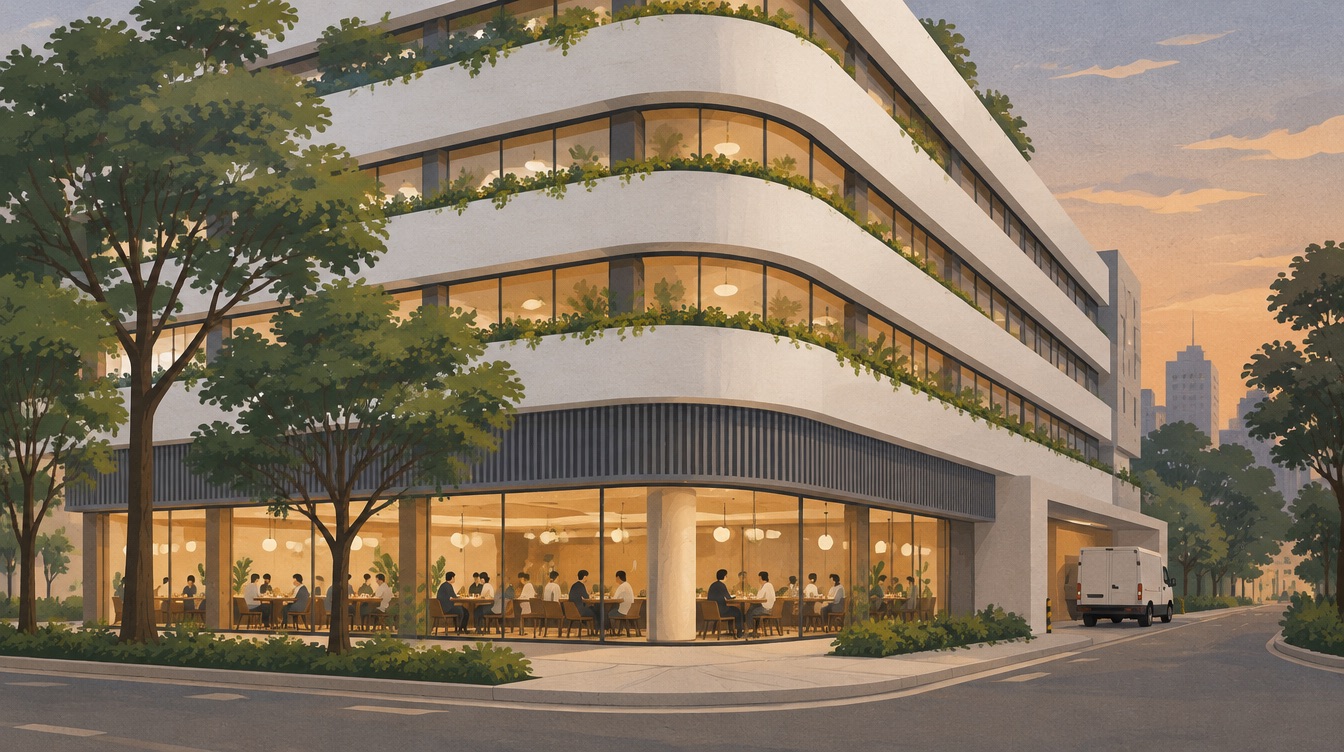
Yes, some industrial buildings can have restaurants, but only where the land's zoning allows it. BreadTalk's headquarters at 30 Tai Seng Street is industrial land zoned Business 2 – White. The "White" part lets a share of the building be used as shops and restaurants. That is why its ground floor opened in 2013 with Din Tai Fung, Toast Box and a Food Republic food court, which a plain industrial building could not hold.
When BreadTalk sold the building in 2021, those uses went with it.
What happened at 30 Tai Seng Street
| Date | What happened |
|---|---|
| 1 Feb 2010 | The land lease starts: 30 years, with an option for 30 more |
| Aug 2011 | Construction of the BreadTalk IHQ begins |
| Jun 2013 | Level 1 opens with Din Tai Fung, RamenPlay, BreadTalk, Toast Box and Food Republic |
| 15 Jan 2021 | A consortium led by Lian Beng agrees to buy the building from BreadTalk for S$118 million |
| 5 Mar 2021 | Lian Beng's subsidiary exercises the call option |
| Apr 2021 | The purchase completes, and BreadTalk leases the building back |
Lian Beng's filing describes the property as a "10-storey high, single-user industrial development with retail component", and gives the S$118 million price, which included the building's mechanical and electrical equipment.
The sale was a sale and leaseback. BreadTalk stays on as "an anchor tenant for an initial lease term of 10 years", with "an option to buy back the Property at a price mutually agreed by both parties or renew the lease term for another 5 years at the prevailing market rent." BreadTalk's chairman said the sale was "part of our capital re-allocation strategy towards a more asset-light model as we continue to focus on our core F&B business."
The restaurants opened in 2013, eight years before the sale, under the land's zoning.
The rule: Business 2 – White
On URA's Master Plan, the plot reads Business 2 – White with a plot ratio of 3.5, of which at least 2.5 must go to industrial use. URA explains where this zoning comes from: "B2 sites located next to MRT stations may be zoned B2-W. The white component is to provide flexibility for industrial companies in such locations to accommodate synergistic White uses." The building is a short walk from Tai Seng MRT.
The industrial part comes first. URA: "a minimum GPR shall be achieved for the permissible B2 uses first. This minimum GPR for B2 uses is indicated in the square brackets on the Master Plan." Only the floor area above that minimum can be used for White uses, which here is up to 1.0 of the 3.5.
URA lists what the White part can hold: "Shop / Restaurant / Showroom / Association, C&CI uses / Office (includes bank), Commercial School / Sports and Recreation facilities, Fitness Centre". It adds that "The actual allowable uses shall be subject to planning evaluation."
What a plain industrial building gets instead
On industrial land without the White part, food is limited to a canteen for workers. URA allows an industrial canteen "on Temporary Permission for up to 5 years", and "The size of the industrial canteen is capped at 700sqm or 5% of the total proposed GFA of the development, whichever is lower."
A canteen on a temporary permission serves the people who work in the estate. A floor of branded restaurants open to the public is a White use, and only land zoned for it can have one.
What an owner can check about their own building
This list covers the checks that come up most often for commercial and industrial owners. It is not complete, and your architect or the agency concerned may ask for more.
The zoning on your plot
Why it matters. The zoning sets the ceiling on what your building can be used for. Two industrial buildings side by side can allow very different tenants if one plot carries a White part and the other does not.
How to check. Search the address on URA SPACE, URA's free online map, and look at the Master Plan land use. An industrial plot reads B1 or B2, and a White part shows as B1-W or B2-W, with the industrial minimum in square brackets.
What was actually approved
Why it matters. The Master Plan says what the land could allow. The planning permission says what your building has. A buyer or tenant will ask for the approved use of the unit they are looking at, not the zoning of the street.
How to check. URA SPACE lets owners look up planning decisions, and URA's Enquiry on Approved Use gives the approved use of a unit for a fee. Keep the approvals with the building's papers.
What the industrial share means for your tenants
Why it matters. URA requires that "At least 60% of the total B2 industrial GFA (i.e. minimum 60%) shall be used for industrial purpose. The remaining 40% may be used for ancillary (or supporting) uses." A building that lets out space is held to the same rule: "Single-user/owner developments (i.e. not strata subdivided) that sub-lease space to other tenants are subject to the same quantum controls as multi-user developments". So when choosing tenants, the owner has to keep the building within that split.
How to check. Compare each tenant's use with the building's approvals before you sign the lease.
JTC's conditions, if the land is a JTC lease
Why it matters. On JTC land, JTC has its own say on who may occupy the building. JTC lets lessees sublet "up to 30% of the overall GFA", and "Failure to obtain JTC's approval to sublet shall be considered as a breach of the lessee's lease conditions". A sale and leaseback like BreadTalk's has its own JTC route: a buyer who "Buys a facility from an industrialist and leases it back to them", where the seller as anchor tenant "must occupy at least 70% of the Gross Floor Area (GFA) of the facility."
How to check. Read your lease with JTC, and ask JTC before you sublet or sell.
The lease remaining
Why it matters. The BreadTalk IHQ's land runs 30 years from 2010, with an option for 30 more. Whatever the building is allowed to hold, it holds only until the lease runs out.
How to check. The title or the lease with JTC gives the start date, the term and any option to extend.
Common questions
Can an industrial building in Singapore have restaurants?
Only where the zoning allows it. On a plot zoned B1-White or B2-White, URA lists restaurants among the uses the White part can hold, subject to planning evaluation. On plain industrial land, food is limited to an industrial canteen, capped at 700sqm or 5% of the floor area, whichever is lower, on a temporary permission of up to 5 years.
Who bought the BreadTalk IHQ?
Lian Beng (Tai Seng) Pte. Ltd., a Lian Beng subsidiary, bought it from BreadTalk Group Pte. Ltd. in 2021 for S$118 million, according to Lian Beng's filing with SGX. BreadTalk leases it back as anchor tenant.
Does a White zoning mean any unit can become a restaurant?
No. The industrial share has to be met first, URA says the actual uses are "subject to planning evaluation", and each unit has its own approved use. Check the approval for the specific unit.
Where do I find my building's zoning?
On URA SPACE, URA's free online map, under the Master Plan land use. The zoning code and the industrial minimum in square brackets are shown for each plot.
Talk it through
If you own a commercial or industrial building and want to know what it is approved for, and what kinds of tenant that allows, send me the address. I go through the zoning and the approvals with you, then we look at leasing or selling.